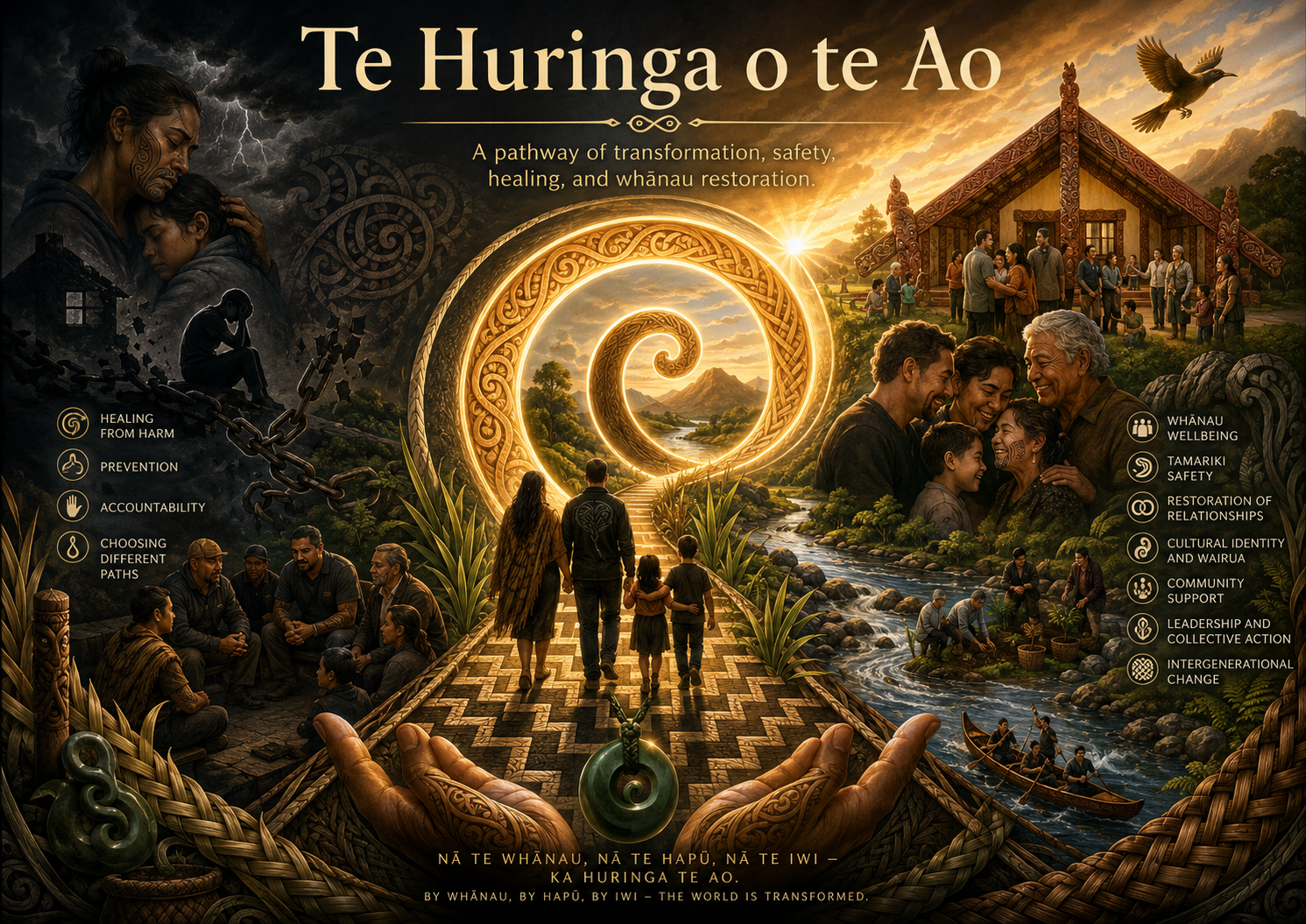
TE HURINGA O TE AO & FATHERS FOR FAMIILES
Te Huringa ō Te Ao means more than change — it speaks to a turning point, a shift in direction, and the possibility of transformation. For Fathers For Families, this kaupapa has helped give language, structure, and national alignment to the work we have been developing with men, fathers, partners, children, and whanau.
Te Huringa ō Te Ao is an MSD-led kaupapa that supports locally-led services for men who are ready to take responsibility for violence and make lasting behaviour change. Its focus is not a short-term, one-size-fits-all response, but flexible, proactive, whānau-centred, culturally responsive support that holds men accountable while supporting growth, healing, and restoration.
For FFF, this framework helped confirm what our practice had already been showing us: men do not change through information alone. Change requires relationship, accountability, identity, healing, cultural connection, spiritual grounding, whānau restoration, and long-term support.
Te Huringa o Te Ao Service Aspiration
Supporting Whanau Wellbeing:
Safe & Healthy Masculinity:
Responsibilty & Accountability:
Supporting tane and men as fathers:
Healthy Relationships:
Supporting healing and connection with whanau:
Strengthening cultural identity, language, and whakapapa:
Te Huringa o te Ao is more than a framework — it is a call to transform the world around our whAnau.
At Fathers For Families, Te Huringa ō Te Ao has helped shape our 14-week programme into more than a family violence intervention. It has helped us build a pathway of transformation — where men are supported to take responsibility, restore safety, reconnect with identity, heal relationships, and become the fathers, partners, and men their whānau need them to be.
Grounded in Te Aorerekura, guided by Te Huringa ō Te Ao, and expressed through the lived practice of FFF, our programme seeks long-term change — not only for the man, but for his partner, his children, his whānau, and the generations still to come.
FFF places the wellbeing and safety of partners, children, and whanau at the centre of the change journey. The programme helps men understand the ripple effects of their behaviour and the responsibility they carry in restoring
How FFF Responds Through the 14-Week Programme
The programme challenges harmful beliefs about manhood and replaces them with strength grounded in humility, responsibility, emotional awareness, protection, service, and love.
Men are supported to take ownership of their actions without blame-shifting, minimising, or excusing harm. Tools such as the Stickman reflections, SCI Mindset System, and group accountability help men face themselves honestly.
The fatherhood section of the programme helps men reflect on the father they are, the father they want to become, and the legacy they are leaving for their children.
The husband/partner section helps men understand how violence, control, silence, fear, sexuality, mistrust, and emotional disconnection affect intimate relationships. It supports men to rebuild trust through safer behaviour.
FFF creates space for healing through group work, one-on-one support, marae-based wananga, peer support, health and wellbeing activities, and alumni pathways.
The programme includes whakapapa, identity, Te Ao Māori, Pasifika values, Te Vā, tikanga, biblical principles, and reflection on the intergenerational patterns men carry and can choose to change.
These seven aspirations are part of the Te Huringa ō Te Ao framework, which is based on evidence, research, sector engagement, and the voices of men & fathers.
The Role of Te Aorerekura &
Fathers FOR FAMILIES
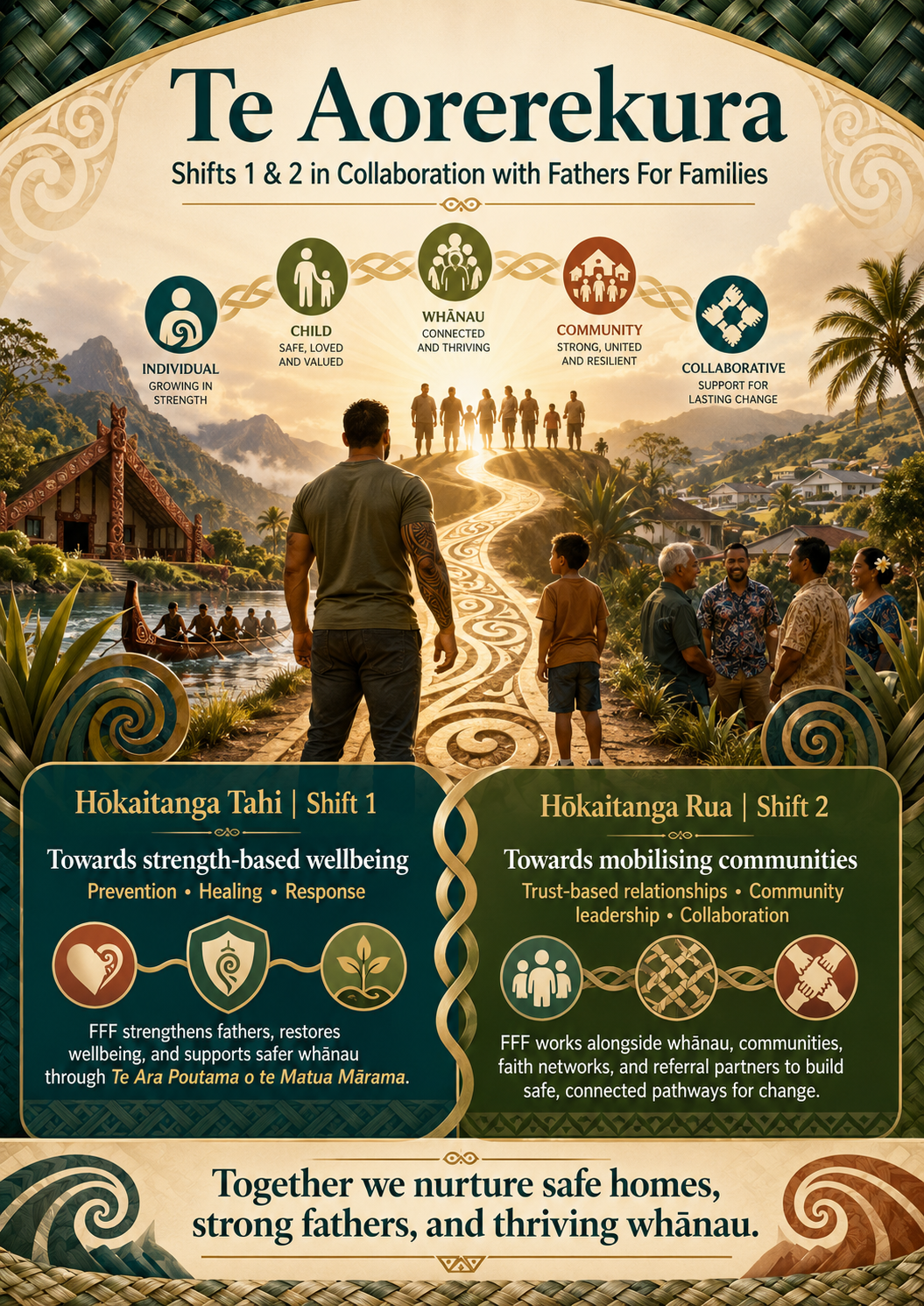
Alongside Te Huringa ō Te Ao, FFF also aligns its mahi with Te Aorerekura, Aotearoa New Zealand’s National Strategy to Eliminate Family Violence and
Sexual Violence. Te Aorerekura sets out a 25-year vision where people are safe, supported, and able to live free from family violence and sexual violence.
Te Aorerekura identifies six key shifts for change:
Towards strength-based wellbeing
Towards mobilising communities
Towards skilled, culturally competent and sustainable workforces
Towards investment in primary prevention
Towards safe, accessible and integrated responses
Towards increased capacity for healing
For FFF, these shifts helped move our thinking from simply delivering a programme to building a wider ecosystem of change.
That means the 14-week programme does not stand alone. It connects to intake, assessment, social work support, peer support, gym, Walk & Talk,
marae wananga, alumni, leadership development, employment pathways, couples work, mothers, tamariki, and wider whanau restoration.
In simple terms:
Te Aorerekura gave FFF the national direction.
Te Huringa ō Te Ao gave FFF the behaviour-change framework.
FFF shaped these into a practical, culturally grounded, faith-informed, whanau-centred 14-week pathway for men and fathers.
How This Looks in Practice
Through Te Ara Poutama o te Matua Mārama, FFF walks with men through four key stages of change:
1. For the Man
The journey begins with identity. Men explore who they are, where they come from, what shaped them, and how violence, trauma, silence, shame, anger, and learned behaviour may have influenced their lives.
This stage includes whakapapa, whanaungatanga, emotional awareness, mindfulness, anger, family harm, and the beginning of personal accountability.
2. For the Husband or Partner
The programme then moves into relationships. Men are supported to understand the impact of their actions on their partner, the difference
between love and control, and the importance of trust, safety, respect, communication, and repair.
This section helps men move away from entitlement and defensiveness toward humility, listening, empathy, and responsibility.
3. For the Father
The third part focuses on fatherhood. Men reflect on their role as fathers, the impact of their behaviour on their children, and the
legacy they are creating. This stage supports men to become more present, emotionally safe, responsible, loving, and intentional in
the lives of their children.
4. My Journey of Success
The final stage focuses on consolidation, graduation, and the next pathway. Men are encouraged to continue their growth beyond
the 14 weeks through alumni, peer support, leadership development, health and wellbeing, and ongoing connection.
This is where behaviour change becomes more than a course — it becomes a way of living.
Alignment Statement
Te Aorerekura gives FFF the national direction.
It reminds us that ending family violence requires long-term, collective, community-led change.
Te Huringa ō Te Ao gives FFF the behaviour-change framework.
It helps guide how we support men to take responsibility, restore safety, and build healthier relationships.
FFF brings these frameworks into practical action.
Through our 14-week programme, social work support, marae-based wananga, peer support, health and wellbeing pathways, alumni, leadership development, and whanau-centred practice.
Fathers For Families contributes to these shifts through its 14-week family violence intervention programme, culturally grounded practice, trauma-informed support, faith-based values, and long-term pathways for men, fathers, partners, children, and whAnau.
Te Aorerekura Shift:
Shift 1: Towards strength-based wellbeing
Shift 2: Towards mobilising communities
Shift 3: Towards skilled, culturally competent and sustainable workforces
Shift 4: Towards investment in primary prevention
Shift 5: Towards safe, accessible and integrated responses
Shift 6: Towards increased capacity for healing
What this means:
Moving away from only seeing people through harm, risk, or deficit, and instead recognising their mana, potential, whakapapa, identity, and capacity to change.
Communities, whanau, iwi, hapu, churches, providers, and local networks are active partners in preventing and responding to family violence.
Building a workforce that is capable, culturally grounded, trauma-informed, safe, reflective, and sustainable.
Preventing violence before it escalates by addressing beliefs, behaviours, trauma, social norms, relationship patterns, and intergenerational harm.
Ensuring people can access safe, coordinated, culturally appropriate support when family violence or sexual violence is present.
Creating space for long-term healing, restoration, accountability, and recovery for people impacted by violence.
How Fathers For Families Fulfils This Shift:
FFF works with men from a strengths-based approach, helping them move from shame, anger, violence, and disconnection toward responsibility, identity, healing, fatherhood, and restoration. Through tools such as the Stickman Assessment, whakapapa reflection, Te Whare Tapa Whā, Vā, and biblical principles, men are supported to understand who they are, what shaped them, and who they can become
FFF is community-led and relationship-based. The programme works with fathers, partners, children, whanau, Corrections, Police, Oranga Tamariki, Family Court, churches, community providers, and local support networks. FFF’s kaupapa recognises that change does not happen in isolation — men need positive community, accountability, and belonging around them.
FFF strengthens workforce capability through trained facilitators, co-facilitators, alumni pathways, supervision, case-note systems, programme evaluations, and reflective practice. The programme is grounded in Te Tiriti o Waitangi, Te Ao Māori, Pasifika values, trauma-informed practice, and biblical principles, ensuring staff can work safely and effectively with men and whanau from lived-experience backgrounds.
FFF contributes to prevention by helping men identify the root causes of violence, anger, control, emotional suppression, and harmful relationship patterns. Through Te Ara Poutama o te Matua Mārama and Te Ara Whakamua, men are supported to break cycles before they are passed on to partners, children, and future generations.
FFF provides accessible pathways through referrals from Corrections, Police, Oranga Tamariki, Family Court, self-referrals, whanau, and community agencies. Support includes group sessions, one-on-one engagement, social work support, court support, whanau hui, health and wellbeing activities, and coordinated case management through Apricot CRM.
FFF recognises that stopping violence is only the beginning. Men are supported to heal from trauma, rebuild trust, restore relationships where safe and appropriate, reconnect with culture and faith, and become safer fathers, partners, and community members. Healing is carried through the 14-week programme, marae-based wānanga, peer support, alumni groups, leadership pathways, and whanau-centred support.
Fathers For Families aligns with Te Aorerekura by contributing to all six national shifts required to eliminate family violence and sexual violence in Aotearoa New Zealand.
Our work is grounded in the belief that men are not defined only by their worst actions, but they must be supported and challenged to take responsibility, understand the impacts of their behaviour, heal from the roots of harm, and rebuild safe relationships with their partners, children, whanau, and communities.
Through our 14-week programme, Te Ara Poutama o te Matua Mārama, FFF supports men to move from violence, disconnection, shame, and survival-based behaviour toward accountability, healing, identity, fatherhood, leadership, and restoration.
Our practice gives effect to Te Aorerekura by:
Restoring mana and wellbeing through strengths-based, trauma-informed, culturally grounded support.
Mobilising community by working alongside whanau, agencies, churches, Corrections, Police, Oranga Tamariki (OT), and local support networks.
Growing skilled and culturally competent practitioners through supervision, reflective practice, co-facilitation, alumni development, and lived-experience leadership.
Investing in prevention by addressing the root causes of violence, intergenerational harm, emotional suppression, and unhealthy relationship patterns.
Providing safe and integrated responses through referral pathways, case management, social work support, court support, whanau hui, and coordinated programme delivery.
Increasing capacity for healing by creating long-term pathways for men, fathers, partners, children, and whanau to restore trust, safety, connection, and hope.
Closing Statement
FFF fulfils Te Aorerekura not only by responding to family violence after harm has occurred, but by walking with men toward transformation — from harm to healing, from isolation to accountability, from broken trust to restored relationships, and from surviving as men to becoming safe, present, and visionary fathers.